
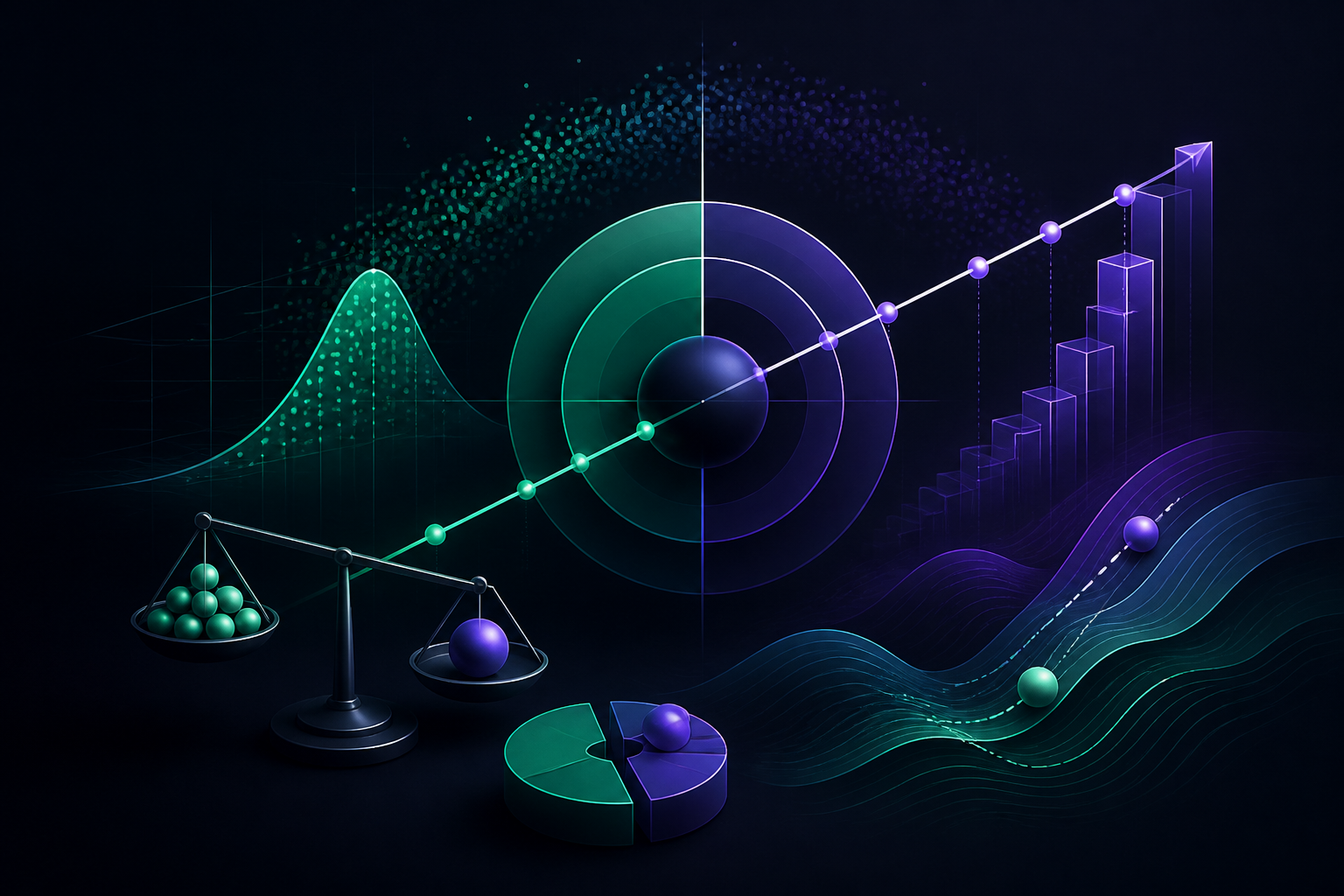
Methodological Calibration: An Analytical Framework for Probability Estimation
A technical evaluation of cognitive calibration, Brier scores, and the systematic elimination of heuristic bias for the professional forecaster seeking analytical precision.
iPredikt Team
September 4, 2026
Technical Evaluation: How to Improve Probability Estimation Skills
In the domain of professional forecasting, the transition from intuitive speculation to algorithmic precision requires a rigorous adherence to the principles of calibration. Within this analytical ecosystem, the objective is not the binary identification of outcomes, but rather the alignment of subjective confidence levels with objective empirical frequencies. To understand how to improve probability estimation skills, the professional evaluator must first internalize the concept of the Brier score—a proper score function that measures the accuracy of probabilistic forecasts by calculating the mean squared error between predictions and actual results.
The refinement of these skills necessitates the systematic dismantling of the overconfidence effect, a cognitive friction point where a forecaster's subjective certainty exceeds their objective hit rate. By treating each event as a multi-variant data set rather than a narrative sequence, the forecaster can isolate the fundamental signal from the environmental noise that frequently leads to predictive drift.
Methodological Framework: The Quantification of Uncertainty
Improving one's predictive capacity involves the application of a structured, scientific approach to high-variance environments. This begins with the identification of a base rate—the structural tendency of an event to occur within a specific class of historical data. For instance, when evaluating whether England will win their opening UEFA Nations League match against Ireland, the evaluator must analyze historical head-to-head performance metrics, squad turnover, and ELO rating differentials to establish a baseline probability before adjusting for idiosyncratic variables.
Within the iPredikt laboratory, the use of an AI Coach serves as a vital tool for calibrating these estimates. By comparing human-generated probabilities against machine-optimized models, the forecaster can identify systematic biases in their reasoning. This iterative feedback loop is essential for reducing variance and achieving a state of 'well-calibrated' judgment, where a predicted 70% probability corresponds exactly to a 70% frequency of occurrence over a longitudinal sample.
The Brier Score and Error Reduction
Central to the enhancement of forecasting skill is the rigorous tracking of performance via the Brier score. A score of 0.0 represents perfect calibration and resolution, while a score of 2.0 indicates total divergence from reality. By maintaining a granular record of predictions, the professional evaluator can differentiate between 'luck'—the influence of stochastic variables—and 'skill'—the ability to identify structural trends.
Consider the task of determining if the Indian Men's Cricket Team will win the final match of the ODI series against Sri Lanka. A skilled forecaster does not simply select a winner; they assign a precise percentage that accounts for pitch conditions, player availability, and recent performance volatility. The subsequent outcome then serves as a data point for future calibration, forcing the evaluator to adjust their mental models if their Forecast IQ indicates a persistent deviation from realized outcomes.
Mitigating Cognitive Friction and Structural Drift
Probability estimation is frequently compromised by the 'availability heuristic,' where recent or emotionally salient events are given disproportionate weight in the analysis. To mitigate this, the forecaster must utilize a 'Reference Class Forecasting' technique. By mapping a current event—such as whether the Springboks will defeat the All Blacks at Ellis Park—onto a broader set of historically similar matchups, the evaluator can neutralize the noise generated by media narratives and public sentiment.
Furthermore, the utilization of Turbo markets on the iPredikt platform allows for the rapid testing of these mental models in compressed timeframes. This high-frequency feedback is a critical component in developing the cognitive architecture required to handle complex, multi-layered data sets without succumbing to fatigue or systemic bias.
Final Assessment: Integration of Tools and Theory
Ultimately, the pursuit of superior probability estimation is a perpetual exercise in intellectual humility and data-driven adjustment. The professional evaluator recognizes that no single forecast is definitive, but rather a contribution to a growing body of evidence regarding their own analytical accuracy. Through the application of the iPredikt AI Coach and the rigorous monitoring of Brier scores within the Arena mode, the forecaster transforms from a passive observer into a precision-oriented architect of expectations.
Evaluate the current variables regarding whether South Africa will win the second T20I match against Namibia and apply your calibrated probability to the market to test your Forecast IQ against the community and AI benchmarks.
Think you can call it?
Back your take, watch the odds move in real time, and exit positions anytime.
Explore markets